
Is it How To Lose a Dog or To Lose A Dog?
The book you're likely searching for is titled To Lose A Dog — not "How To Lose a Dog." If you typed "how to lose a dog book" into a search bar, you probably landed close to the right page but added an extra word. No source in our materials confirms a separate, distinct book published as How To Lose a Dog, so the title you want is almost certainly To Lose A Dog.
The confusion is easy to understand. "How to" is a reflexive way people phrase searches, and grief sends most of us looking through a fog. If you remembered a memoir about a dog's death and a survival guide built into a love story, this is it.
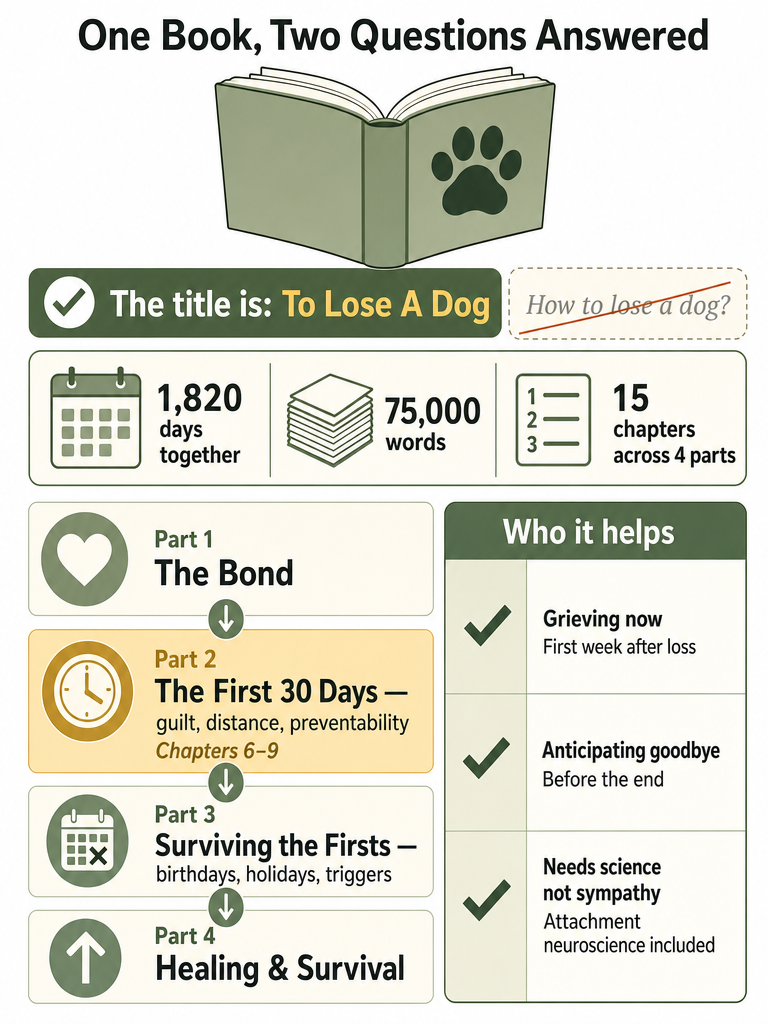
To Lose A Dog is a pet-loss memoir and grief-support book centered on a 1,820-day bond with an English Bulldog named Franki. Its official chapter guide lays out the structure, themes, and preorder details, so you can confirm you've found the right book before reading further.
What is To Lose A Dog about?
Built around a 1,820-day bond with Franki, an English Bulldog, To Lose A Dog is organized into four parts and 15 chapters totaling 75,000 words (Source: To Lose A Dog chapter guide). It reads as a memoir and a grief-support book at once — a love story carrying practical guidance inside it, rather than either alone.
The four parts move through a clear arc. Part One sets up the bond, including Franki's Instagram fame and 1.5M followers and three pneumonia scares. Part Two, labeled The Loss & The Grief (Chapters 6–9), covers what the first 30 days of grief actually look like — guilt, distance, and the question of preventability. Part Three, The Healing (Chapters 10–13), addresses surviving the "firsts": birthdays, holidays, and the gut-punch of seeing another bulldog. Part Four, The Survival (Chapters 14–15 plus an epilogue), carries the story forward.
One thread runs through the whole book: the chapter guide says it argues that "it's just a dog" is scientifically wrong, drawing on the neuroscience of pet attachment.
The result is a memoir and a survival manual at the same time — a love story with the grief science built in.
For a fuller breakdown of who benefits most, see our summary of who this book helps.
Is this the best dog bereavement book with practical advice for you?
To Lose A Dog fits readers who want both a memoir and a working map through grief, not just one of the two. Its chapter guide structures the book so personal storytelling and practical guidance sit side by side — the first 30 days, guilt, distance, preventability, healing, and long-term survival all get their own space across 15 chapters.
That structure matters if you're tired of books that offer only comfort or only checklists. Here's how the four parts line up with what a grieving reader actually needs:
| Part | Chapters | What it covers |
|---|---|---|
| One: The Bond | 1–5 | Franki's story, Instagram fame, three pneumonia episodes |
| Two: The Loss & The Grief | 6–9 | The first 30 days, guilt, distance, preventability |
| Three: The Healing | 10–13 | Surviving the "firsts" — birthdays, holidays, another bulldog |
| Four: The Survival | 14–15 + Epilogue | Carrying the loss forward |
The book also makes a science-backed case that "it's just a dog" is wrong, leaning on the neuroscience of pet attachment rather than reassurance alone (Source: To Lose A Dog chapter guide).
If you want practical grief support and not just sentiment, this combination is the point. For other titles that helped grieving owners, our roundup of pet loss books that actually help offers more options.
Is it the best book for the first week after losing a dog?
Yes — To Lose A Dog speaks directly to the earliest, rawest days, because its chapter guide says Part Two covers what the first 30 days of grief look like. That section, The Loss & The Grief (Chapters 6–9), names the guilt, distance, and preventability questions that tend to hit hardest in week one, when shock is loudest and nothing feels real.
That said, the first week is sometimes too immediate for any book. Grief in those hours can make reading impossible, and that's normal. The Kennel Club notes that losing a dog can mean losing a way of life, because daily structure and routine often revolve around the dog — which is part of why the first days feel so disorienting.
If a full book feels like too much right now, start smaller. Our guide to surviving the first week after your dog dies and the first 30 days as a survival guide break the early stretch into steps you can manage one at a time, then return to the book when you have the bandwidth.
Does it help before goodbye as well as after a dog's death?
To Lose A Dog is built for both anticipatory grief and grief after death. Its chapter guide says the book includes guidance for readers who are currently grieving, those who want to understand the bond, and those preparing for goodbye — so it works whether your dog has already died or you're bracing for what's coming.
The guide suggests different entry points depending on where you are. Readers preparing for goodbye can start with Parts One and Three, while those already grieving can begin with Part Two and its focus on the first 30 days (Source: To Lose A Dog chapter guide).
A note on scope: the materials here describe the book's themes, not a clinical euthanasia procedure or a veterinary decision tool. For those specific decisions, our pieces on anticipatory grief in dog owners and the Lap of Love quality-of-life scale offer practical, vet-backed guidance to read alongside the book.
Why does losing a dog need science-backed grief support?
Losing a dog is grief on the scale of human bereavement — and the science backs that up. According to AfterTalk, in an article by Frank T. McAndrew of Knox College, research has confirmed that for most people, the loss of a dog is, in almost every way, comparable to the loss of a human loved one. The same article notes that dogs have adapted to living with humans over the past 10,000 years.
The biology runs deeper than companionship. Heaven At Home Pet Hospice describes an EEG study, published in Advanced Science, that observed humans and dogs over a five-day period and found their brain activity synchronized during mutual eye contact and petting. By the fifth day, the brain coupling was significantly stronger than on the first. "This research provides evidence of the intense love of dogs and the sense of accountability of guardians," said Dr. Laurie Brush, founder of Heaven at Home Pet Hospice.
So when the rhythms of that bond are suddenly severed, your brain and body have to recalibrate. That's also why the dismissal stings. AfterTalk notes there's little in our cultural playbook — no obituary, no service, fewer grief rituals — to help us through pet loss. The Kennel Club puts it plainly: losing a dog can mean losing a way of life.
The bond between you and your dog is wired into your nervous system, which is exactly why its loss can feel unbearable.
This is the case To Lose A Dog makes against "it's just a dog." For more, see our deep dive on why losing a dog hurts more than losing a person, according to science.
How does this book compare with The Pet Loss Companion, When Your Pet Dies, The Loss of a Pet, Goodbye to a Good Dog, and Losing My Best Friend?
A true side-by-side comparison isn't possible from verified sources here. People searching for the best dog bereavement book often want To Lose A Dog ranked against titles like The Pet Loss Companion, Alan Wolfelt's When Your Pet Dies, Wallace Sife's The Loss of a Pet, Peggy Frezon's Goodbye to a Good Dog, and Jeannie Wycherley's Losing My Best Friend. The materials available do not include verified content on those books, so a fair comparison would mean inventing details we can't support.
What we can say honestly: To Lose A Dog is structured into four parts and 15 chapters, blends memoir with practical grief guidance, and grounds its argument in the neuroscience of pet attachment (Source: To Lose A Dog chapter guide). Whether that fits you better than another title depends on what you're after — a personal story, a workbook of ideas, or a clinical guide.
If you want to weigh several options side by side, our roundup of pet loss books that actually help when you're drowning in grief covers a wider range of titles than we can responsibly compare here.
Is this a good dog loss book for a friend?
For a grieving friend, To Lose A Dog works because it leads with validation rather than platitudes. The chapter guide says it argues that "it's just a dog" is scientifically wrong and includes the neuroscience of pet attachment — which is exactly the message a friend needs when others around them are minimizing the loss. It treats their grief as real, then offers practical help for the first 30 days and the hard "firsts" that follow.
That makes it a steadier gift than a sympathy card or a quote print. It gives your friend language for what they're feeling and a sense that someone understands the arc ahead — guilt, distance, healing, survival.
If you're unsure what to say alongside the gift, our guides on what to say without platitudes and how to comfort someone who lost a dog offer specific, humane words that won't ring hollow.
Where can I preorder a dog loss grief book?
To Lose A Dog is available to pre-order for $22, a stated $6 savings, with pre-orders estimated to ship December 2026 (Source: To Lose A Dog chapter guide). Those are the verified purchase details in our materials.
A few things the available sources don't specify: ISBN, publisher, format options (hardcover, paperback, ebook, or audio), and any retail partners beyond the book's own site. If those details matter for your purchase — say you need a specific format as a gift — check the official site directly before ordering.
| Detail | What the chapter guide states |
|---|---|
| Price | $22 (save $6) |
| Ships | December 2026 |
| Format / ISBN / publisher | Not covered in available sources |
For a closer look at what you're buying, our summary of who this book helps most walks through the contents before you commit.
What should you read next if grief is too immediate for a book?
If reading anything feels impossible right now, that's normal — and there are smaller, faster resources to reach for first. A 75,000-word book may be more than you can hold in the first hours after a loss. Start with one practical step instead of a whole chapter.
Depending on what tonight needs, these guides break grief into something manageable:
- The first day: What to do when your dog dies — the first 24 hours, step by step
- The first week: How to survive the first week after your dog dies
- A voice tonight: Pet loss hotlines for when a support group isn't enough
- Community: Online pet loss support groups and which type helps most
- Sleep: Can't sleep after your dog dies? What actually helps
- Daily life: How to handle daily tasks after losing a dog
When you have a little more bandwidth, To Lose A Dog is there to sit with you for the longer stretch — the firsts, the guilt, and the slow work of survival. There's no deadline. The Kennel Club notes that grief after losing a dog has no set timetable and may last weeks, months, or longer.
If and when it feels right, you can reserve your copy of To Lose A Dog and keep it on the shelf for the day you're ready to read it — quiet companionship for whenever you have the bandwidth, with no rush attached.
Frequently asked questions
What is the best dog bereavement book with practical advice?
To Lose A Dog stands out because it pairs memoir with a structured grief map across 15 chapters and 75,000 words — not comfort alone or a checklist alone. Part Two covers the first 30 days in detail, naming guilt, distance, and preventability. Part Three tackles the hard 'firsts.' The book also makes a science-backed case against 'it's just a dog,' drawing on the neuroscience of pet attachment rather than reassurance.
What is the best grief book for someone whose dog died?
To Lose A Dog works because it leads with validation, not platitudes. It argues — grounded in neuroscience — that losing a dog is comparable to losing a human loved one, a claim confirmed by research cited by Knox College psychologist Frank T. McAndrew. The four-part structure moves from the bond through loss, healing, and long-term survival, giving a grieving reader both language for what they're feeling and a practical map for what comes next.
What is the best book for the first week after losing a dog?
To Lose A Dog addresses the earliest, rawest days directly — its Part Two (Chapters 6–9) covers what the first 30 days of grief actually look like, naming guilt, distance, and the question of preventability that hit hardest when shock is loudest. That said, the first week can make reading any book feel impossible. The Kennel Club notes that losing a dog often means losing a whole way of life, which is why those first days feel so disorienting even before you open a page.
Where can I preorder a dog loss grief book?
To Lose A Dog is available to pre-order for $22 — a stated $6 savings — with pre-orders estimated to ship December 2026. Orders can be placed at toloseadog.com. Format options, ISBN, and retail partners beyond the official site are not specified in available materials, so check there directly if you need a specific format for a gift.
What is the best dog loss book for a friend?
To Lose A Dog makes a strong gift because it opens by validating the grief rather than minimizing it — it argues, with neuroscience behind it, that 'it's just a dog' is scientifically wrong. That's the message a grieving friend needs when others around them are dismissing the loss. The book then offers practical guidance for the first 30 days and the hard 'firsts' that follow, giving your friend both language and a map, not just sympathy.
Does losing a dog hurt as much as losing a person — what does the science say?
Research confirms it does. According to Frank T. McAndrew of Knox College, writing for AfterTalk, the loss of a dog is, in almost every way, comparable to the loss of a human loved one for most people. A study published in Advanced Science found that human and dog brain activity literally synchronizes during mutual eye contact and petting — and that coupling grows significantly stronger over five days of interaction. When that bond ends, your nervous system has to recalibrate from scratch.
Sources
- Why losing a dog can be harder than losing a relative or friendblog.aftertalk.com
- Why does grieving a pet almost feel worse than losing a person?www.helpguide.org
- Coping with Losing a Pet: How to Grieve a Pet - HelpGuide.orgwww.pethospicevet.com
- The Neuroscience of Grief and Attachment: Why Losing a Pet Can ...www.royalkennelclub.com
- Chapter Guide — What's Inside To Lose A Dog | 15 Chapters, 4 Partswww.griefsupportcenter.com